At Valves Only, a Supplier in USA, Knife Gate Valves are essential for pipelines handling slurries, viscous fluids, and media with suspended solids. Their unique design allows the gate to cut through thick or abrasive materials, ensuring smooth and controlled flow where traditional valves struggle.
Commonly used in wastewater treatment, chemical processing, power generation, pulp and paper, and mining, knife gate valves function particularly well in low-pressure systems needing little pressure drop. Made to resist corrosive and abrasive settings, they are available in flanged, lug, and wafer styles and in materials including carbon steel, stainless steel, and alloys.
Engineers and operators may select the best valve for difficult industrial uses by knowing its design, material grades, and flow characteristics.
Key Features and Technical Design
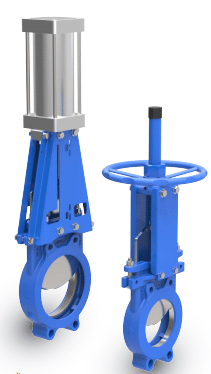
Flat, sharp-edged gates that move vertically to allow or limit flow characterize Knife Gate Valves. Their basic but efficient system creates a complete bore path in the open posture, hence lowering pressure drop and avoiding solids accumulation.
Gate and Seat Design
- Gate: Usually it is composed of stainless steel grades like SS304, SS316, or SS316L, the gate offers wear protection and corrosion resistance in abrasive settings. For extreme abrasive slurries, hard-faced gates with stellate coating are found.
- Seats: Resilient seats made of EPDM, NBR, PTFE, or Vulcanized Rubber guarantee tight shutoff at low pressure. For even more strength, some high-pressure knife gate valves employ metal-to-metal seats.
- Seal Types: To stop leakage, knife gate valves can have compression seals, soft elastomer seals, or double-seated designs.
Valve Body Construction
- Material Grades: Carbon steel (ASTM A216 WCB, A350 LF2), Stainless steel (ASTM A351 CF8/CF8M), or Alloy steel (ASTM A217 WC6/WC9) define the construction of standard bodies for applications involving high temperature and pressure.
- Design Types:
- Wafer Type: Compact design, installed between flanges, suitable for low-pressure systems.
- Lugged Type: Bolted to flanges, allows downstream isolation for maintenance.
- Flanged Type: Full flanges, provides maximum strength and sealing.
- Bonnet Styles: Top-entry and side-entry bonnets ease actuator installation and provide maintenance access.
Stem and Actuation
- Stem Type: Standard rising stems give valve position visual indication. Compact installations employ non-rising stems.
- Actuation: Automatic actuation using pneumatic, hydraulic, or electric actuators or manual operation using handwheels, bevel gears, or chain wheels are available for knife gate valves
- Stem Seals: PTFE, graphite, or synthetic rubber make up the packing material employed to stop stem leaks.
Operation Mechanism
The operation of Knife Gate Valves is straightforward yet effective for thick media:
- Opening: Rotating the handwheel or actuator raises the gate to provide a clean full-bore path permitting media to flow with little resistance.
- Closing: Closure lowers the gate, which cuts across solids and presses against the seat, so completely stopping the flow.
- Throttling: Originally intended for on/off use, knife gate valves also serve to throttle. Although limited throttling is possible, it can lead to flow-induced vibration, which could wear on the gate and seat.
The full bore arrangement lowers pressure drop and turbulence; the sharp gate edge guarantees solids don't clog the valve body, creating appropriate knife gate valves for slurry lines.
Flow Characteristics and Performance
Knife gate valves are best suited for particular industrial uses where other valves might not:
- Low Pressure Drop: Open position opens almost unhindered flow, lowering energy losses brought on by low pressure drop.
- Bidirectional Flow: Most knife gate valves can manage flow in either direction. Some designs under extreme pressure may be unidirectional.
- Abrasion Resistance: Hard-faced gates or stainless steel building offers resistance against erosive slurries.
- Pressure and Temperature Ratings:
- Normal resilient-seated valves, Class 150–300, PN10–PN16.
- PN25–PN40, Class 600–900for metal-seated valves.
- Soft-seated models have a temperature range of -40°C to 200°C; metal-seated types may reach up to 400°C.
Installation Guidelines
| Parameter | Recommendation |
| Orientation | Horizontal installation preferred; vertical installation allowed with appropriate support. |
| Flange Alignment | Ensure accurate alignment to prevent gate binding. |
| Pipeline Support | Provide external support to reduce stress on the valve body. |
| Accessibility | Allow clearance for handwheel or actuator operation. |
| Downstream Clearance | Avoid immediate elbows or pumps to reduce turbulence and wear. |
Performance and Reliability Under Challenging Conditions
Knife gate valves are engineered to deliver consistent performance in demanding industrial environments:
- Abrasion and Corrosion Resistance: Hard-faced gates and stainless steel materials protect against erosive slurries, chemical attack, and fibrous media.
- Sealing Reliability: Resilient or metal seats ensure tight shut-off under varying pressure and temperature conditions.
- Flow Consistency: The full-bore design minimizes pressure drop and prevents solids accumulation, maintaining smooth media flow.
- Operational Stability: Knife gate valves can handle bidirectional flow and are suitable for low-pressure systems where consistent performance is critical.
- Temperature and Pressure Endurance: Soft-seated valves operate between -40°C to 200°C, while metal-seated designs can withstand temperatures up to 400°C and pressures up to Class 900.
These design and material choices ensure knife gate valves remain reliable, efficient, and durable across industries such as mining, wastewater treatment, pulp and paper, chemical processing, and power generation.
Technical Specifications Table
| Feature | Standard Values / Grades |
| Body Composition | ASTM A216 WCB, ASTM A351 CF8/CF8M, ASTM A217 WC6/WC9 |
| Gate Material | SS304, SS316, SS316L, Stellite-coated for high abrasion |
| Seat Material | EPDM, NBR, PTFE, Vulcanized Rubber, Metal Seats |
| Pressure Rating | PN10–PN16 (soft seat), PN25–PN40 (metal seat), Class 150–900 |
| Temperature Range | -40°C to 200°C (soft seat), up to 400°C (metal seat) |
| Actuation | Manual (handwheel, angel, chain), Pneumatic, Hydraulic, Electric |
| Operation Type | On/Off, Bidirectional |
| End Connections | Flanged, Lugged & Waffer |
Industrial Applications
Knife gate valves are versatile and frequently used across industries:
- Mining and Minerals: Transporting abrasive ores and slurry without clogging.
- Pulp and Paper: Handling wood pulp, chemicals, and other fibroid substances is pulp and paper.
- Wastewater Treatment: Handling heavy effluent, sludge, and liquid with high solid load.
- Chemical Industry: Managing viscous fluids and corrosive mediums.
- Power Plants: Handling solid-laden liquids including coal slurry and fly ash slurry.
Knife Gate Valves are designed for systems carrying viscous, abrasive, or solid-laden media. Their design guarantees simple operation with minimal pressure loss by means of strong or metal seats, a full-bore flow path, and a crisp sliding gate. Selecting the correct material grade like stainless steel, carbon steel, or alloy steel improves valve performance especially in commercial situations by means of choosing the appropriate seat type.
Correct gate, seat, and actuator installation, regular inspection, and timely maintenance are essential to maximize service life and preserve operating efficiency. Meeting with producers to select the ideal material grade, seating design, and actuator choice lets operators and engineers arrange system upgrades or replacements to guarantee the valve meets the demands of the system for media-handling capacity, pressure, and flow.