Precise flow control is the lifeline of every industrial piping network. At ValvesOnly, ball valves, globe valves, and plug valves are essential components that ensure smooth operations, reduce downtime, and enhance overall system performance. Each of these valves offers distinct advantages in controlling the flow of liquids, gases, or slurries, making the choice of the right valve critical for efficiency and safety.
Globe valves shine in exact throttling; ball valves offer rapid shut-off and low-pressure drop; plug valves are adaptable for multi-port flow or isolation uses. Knowing these distinctions enables operators and engineers to make wise choices that guarantee the chosen valve satisfies the operational requirements of the system while preserving dependability and long-term performance.
Why Are These Valves Often Compared?
Discussions of Ball, Plug, and Globe valves sometimes run side by side as they do have applications that overlap in regulating liquids and gases but they also run based on several criteria.
Important justifications of comparison consist of:
- Flow control precision: Each valve provides different levels of shut-off and throttling ability.
- Operational mechanism: Globe valves use a straight motion, which impacts response times; Ball and Plug valves have quarter-turn action.
- Maintenance requirements: Design variations affect how simple it is to repair, check, and replace parts.
- Cost implications: These valve kinds have very different long-term operating and beginning purchasing expenses.
Design and Operation Differences
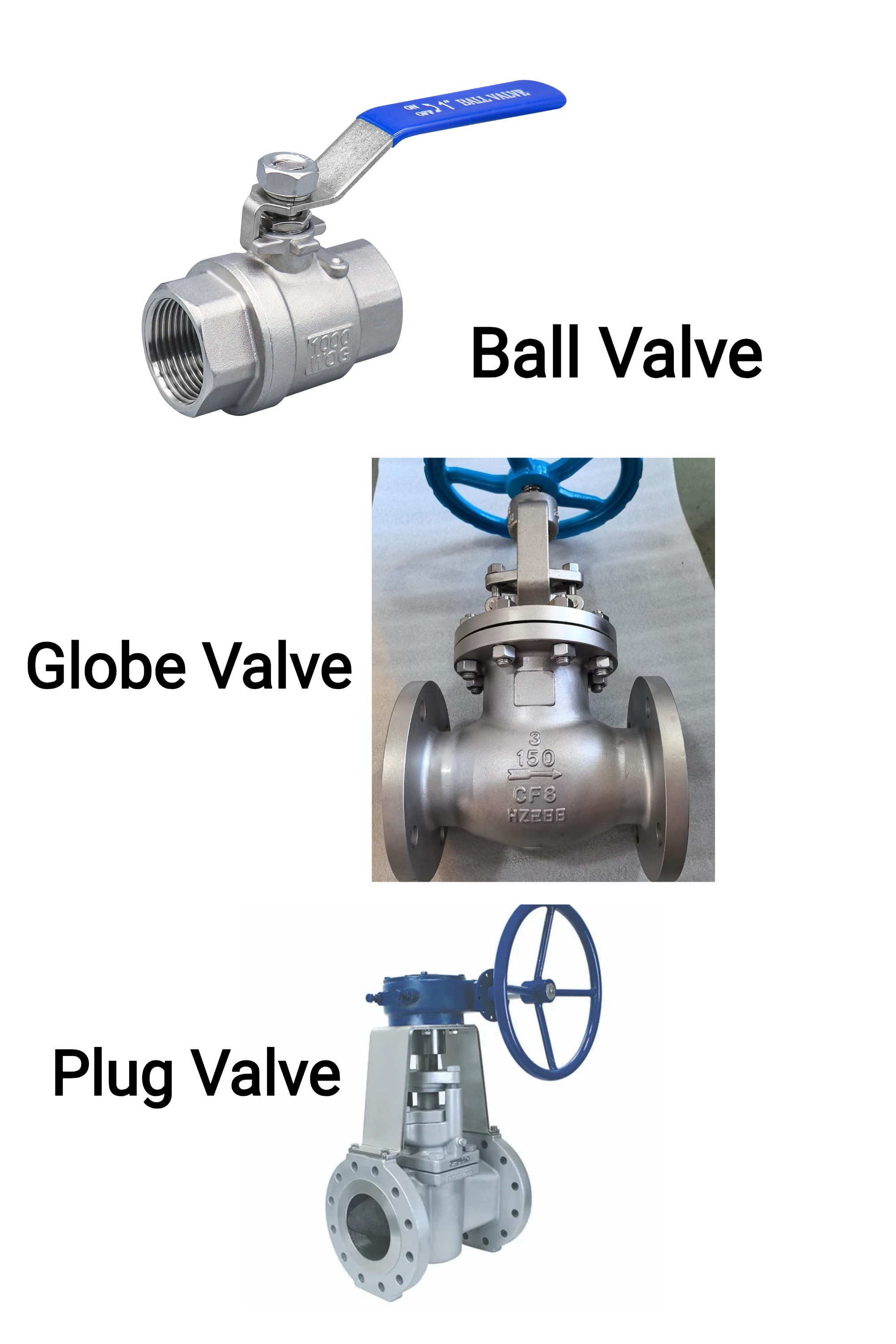
Ball Valve
- Design: Spherical disc (ball) with a central hole; flows through the bore when aligned with the pipe.
- Operation: Quarter-turn rotation (90°) to open or close. Offers quick shut-off and minimal pressure drop.
- Sealing: Typically uses resilient or metallic seats to ensure tight closure.
Plug Valve
- Design: Cylindrical or conically tapered plug rotates inside the valve body; the plug has a passage matching the flow.
- Operation: Also a quarter-turn mechanism; allows full flow with minimal resistance when open.
- Sealing: Uses soft or metallic seats; simpler construction often suited for abrasive or viscous media.
Globe Valve
- Design: Linear motion valve with a movable disk (or plug) against a stationary seat; generally, a globe-shaped body.
- Operation: Rotating handwheel lifts or lowers the disk to regulate flow. Offers precise throttling but slower operation.
- Sealing: Metal-to-metal or soft seat provides tight shut-off; suitable for applications requiring flow modulation.
Flow Characteristics and Performance
Ball Valve
- Provides near-full flow with minimal pressure loss.
- Ideal for on/off operations rather than precise throttling.
- Quick action reduces downtime during emergency shut-off.
Plug Valve
- Minimal obstruction in open position ensures high flow efficiency.
- Suitable for intermittent flow control or bypass lines.
- Performs well in systems handling slurries or viscous fluids due to simple design.
Globe Valve
- Excellent for flow regulation and throttling applications.
- Pressure drop is higher due to the tortuous flow path, especially at partial openings.
- Best for systems where gradual adjustment of flow is critical.
Performance Considerations
Ball Valves: Provide dependable, quick shut-off and little flow resistance. Regular visual checks of the seat help to guarantee consistent performance, especially in high-pressure or high-temperature applications.
Plug Valves: Perfect for thick or sticky liquids; need to be oiled every once in a while to keep the plug and seat working smoothly. Their basic design guarantees great dependability with little involvement.
Globe Valves: Give exact flow control for throttling. Maintaining sealing and regulation accuracy depends on routine packing and movable disk checks. Their design makes component replacement somewhat more complicated than for plug or ball valves.
Engineers can choose valves that match performance with real-world system needs by concentrating on operational efficiency, durability, and integration. Taking these points into account guarantees maximum flow control, reduces downtime, and increases valve service life.
When to Choose Each Valve
Ball Valve
- Best suited for applications requiring fast and reliable on/off operations.
- Commonly used in pipelines where flow needs to be quickly isolated.
Plug Valve
- Ideal for systems carrying slurries, viscous fluids, or abrasive media.
- Suitable for pipelines that require occasional throttling with minimal flow obstruction.
Globe Valve
- Preferred where accurate flow regulation is necessary, such as chemical dosing or cooling water control.
- Effective in processes that require gradual flow changes rather than immediate shut-off.
Matching Valve Selection to System Needs
Deciding which valve to deploy depends on the operational priorities:
- High flow with low resistance: Ball and plug valves outperform globe valves.
- Precise throttling: Globe valves offer superior control.
- Maintenance simplicity: Plug valves are easiest to maintain, followed by ball valves.
- Emergency isolation: Ball valves provide fastest shut-off response.
A careful assessment of these factors ensures optimal system performance and cost management without overcomplicating operations.
Which Valve Type Offers the Best Efficiency in European Industrial Systems?
In European industrial systems, efficiency isn’t just about cost—it’s about energy savings, operational reliability, and precise flow control. Selecting the right valve type can significantly impact these factors.
Ball Valves
- Quick quarter-turn operation ensures fast shut-off.
- Minimal pressure drop preserves energy and reduces pump load.
- Ideal for clean fluids and applications where rapid isolation is critical.
Globe Valves
- Offers precise throttling for accurate flow control.
- Best suited for processes that require gradual adjustments, such as chemical dosing.
- Slightly higher pressure drop but unmatched control precision.
Plug Valves
- Versatile for slurries, viscous fluids, and abrasive media.
- Low obstruction in open position maximizes flow efficiency.
- Simple design reduces maintenance and downtime.
Efficiency depends on the system’s priorities. Ball valves excel in rapid shut-off with low pressure loss, globe valves provide precise throttling, and plug valves offer versatile, low-maintenance solutions. Evaluating flow needs, control precision, and operational conditions ensures the optimal valve choice for European industrial systems.
Every valve has special advantages for systems that control fluid. When rapid shut-off and great flow are priorities, Ball valves excel. With minimal flow restriction, Plug valves offer a low-cost, straightforward choice. Globe valves enable exact throttling when little flow changes are absolutely necessary. Selecting the appropriate valve entails weighing the need for flow, the simplicity of repair, and the criticality of operating it not only which kind appeals to an individual most.
Industrial operators looking for help with valve choice have to value these differences. Knowing this clarifies the system's efficiency and enables one to make wiser decisions. Whether developing fresh systems or upgrading current lines, judging every valve against design, performance, and maintenance requirements ensures the best outcomes.
Knowing valve actuating alternatives helps to attain operational excellence whether you are modifying current systems or developing fresh ones. Investigate several valve solutions thoroughly; match them to your process demands; and check technical data to guarantee smooth flow management in every use. At Valves Only Supplier in USA, we provide detailed technical expertise and valve comparisons to help you make informed choices for optimal flow control performance.