At ValvesOnly Supplier in USA, valves are the backbone of every industrial flow system, from simple water pipelines to complex chemical processing plants. They control, guide, and regulate fluid movement to ensure operational efficiency, safety, and reliability. Among the most commonly compared categories are Actuated Valves and Manual Valves.
While both serve the primary purpose of flow control, they differ significantly in terms of system integration, operational mechanisms, and application solutions. Understanding these differences helps engineers, plant operators, and designers select the valve type that best meets the specific demands of their industrial processes.
With industries increasingly relying on automation and precise control, the choice between actuated and manual valves can directly affect operational speed, accuracy, and overall system performance. Considering factors such as pipeline size, fluid type, frequency of operation, and the level of monitoring required ensures the selected valve maximizes efficiency and longevity while maintaining safety standards across industrial facilities.
Manual and actuated valves are sometimes contrasted for good reason
Manual and Automated valves are primarily different in how they meet the same requirement but in their own ways.
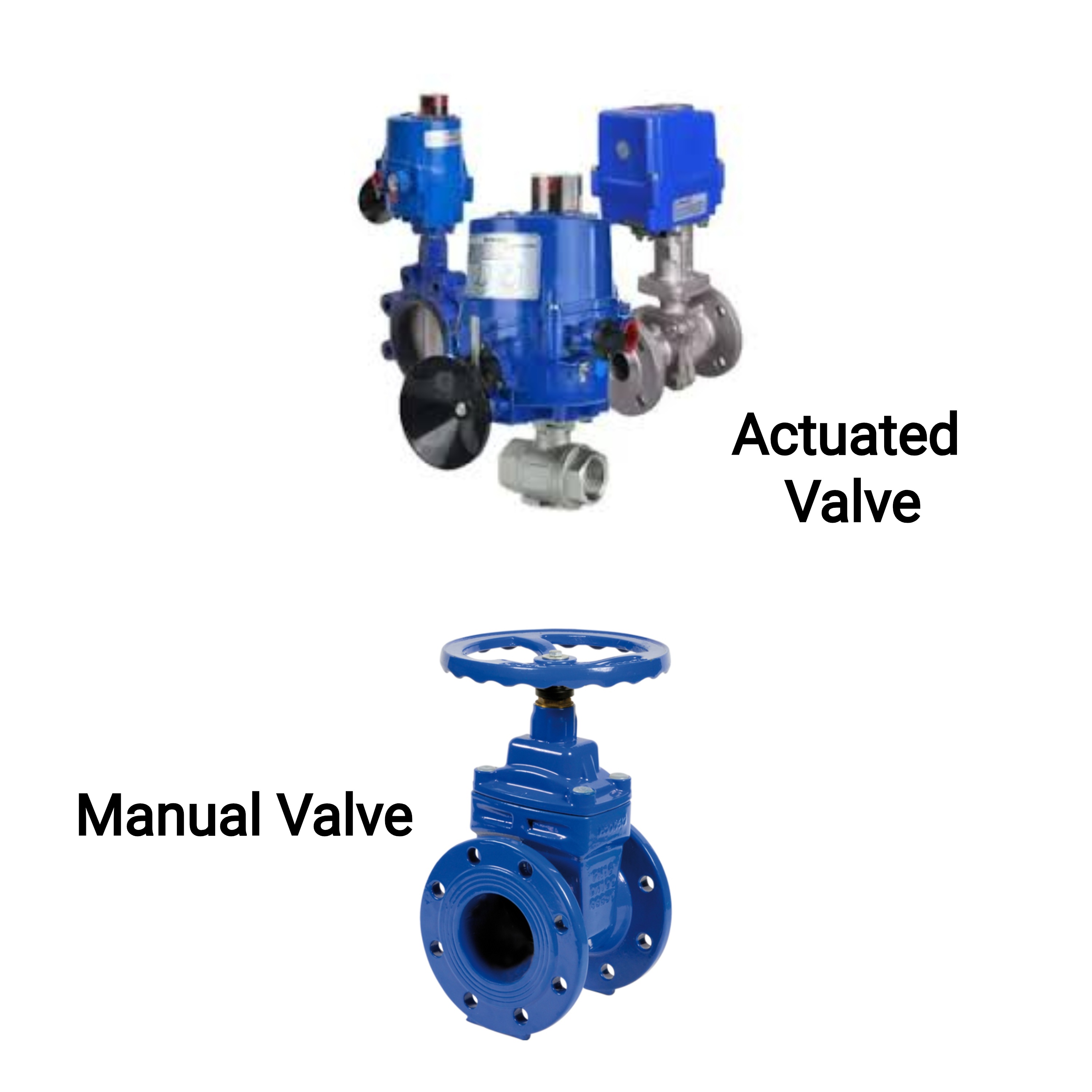
- Manual valves use levers, wheels, or handles to control the flow of fluids. They rely on people to open, close, or change the flow.
- Alternatively, a valve is repositioned using Hydraulic, Pneumatic, or Electric external power sources that move automatically.
Considering cost efficiency, operating safety, or plant automation makes this comparison appropriate. To enhance reaction in crucial applications, reduce human labor, or raise control accuracy, several systems originally with hand valves later switched to automated ones.
Design and Operation Differences
Manual Valves
Manual valves are straightforward in design. Common varieties include gate, globe, ball, and butterfly valves, each run by a hand lever or wheel. The operator manually turns or rotates the handle to change the internal flow path.
- Design Simplicity: No need for external power or wiring, only few moving parts.
- Operation: Direct human control over the valve position.
- Common Uses: Ideal for low to moderate pressure systems, infrequent operation, or applications where precise automation is unnecessary.
Actuated Valves
Actuated valves expand on manual valve ideas by including an actuator that drives the opening and closing mechanism. Electrically, pneumatically, or hydraulically actuating devices can be driven.
- Design Complexity: Involves extra elements including controllers, limit switches, sensors, and positioners.
- Operation: Changes automatically depending on pre-set guidelines or system signals.
- Common Uses: Preferred in automated systems, toxic conditions, or procedures needing rapid or regular action.
Comparison Table: Manual vs Actuated Valves
| Parameter | Manual Valves | Actuated Valves |
| Operation Method | Hand-operated (lever, wheel, or handle) | Automated (electric, pneumatic, or hydraulic) |
| Installation Complexity | Simple, minimal wiring or setup | Complex, requires power supply and control system |
| Response Time | Dependent on human operator | Fast, programmable response |
| Flow Control Precision | Limited, depends on operator skill | High precision with feedback control |
| Maintenance Needs | Low, fewer components involved | Moderate to high, actuator servicing required |
| Cost | Lower initial cost | Higher upfront and maintenance cost |
| Automation Capability | Manual only | Fully automatable, integrates with control systems |
| Ideal Application | Simple, low-frequency operations | Continuous, critical, or remote operations |
| Safety and Accessibility | Requires manual access | Can be operated remotely, safer in hazardous areas |
Flow Characteristics
Manual Valves
- Simple uses find manual valves sufficient for flow control. The operator has the option of manually choking flow, but getting constant intermediate positions might be difficult.
- They are effective in places where flow demand doesn't change often or where safety lets people get close contact.
- Their performance mostly relies on the valve type; ball and gate valves are preferable for on-off service, while globe valves provide superior throttling control. The operator's presence and reaction, however, constrain response time.
Actuated Valves
- For performance-critical systems, actuated valves shine. Perfect for automated process control, their reaction time, consistency, and control precision define them.
- Actuated valves can accurately and continuously change flow by means of control system signals.
- They are very useful in dangerous, hot, or high-pressure settings since they let you work from far away.
- Rapid or frequent cycling uses also suit pneumatic and hydraulic actuators rather nicely.
Energy Efficiency and System Integration
Manual and actuated valves impact industrial systems differently. Understanding their role in energy usage and integration helps optimize overall performance:
Manual Valves:
- Energy Use: No external energy needed for operation.
- System Integration: Simple installation, minimal impact on existing pipelines.
- Best Suited For: Small-scale or low-frequency systems where simplicity and low energy consumption are priorities.
Actuated Valves:
- Energy Efficiency: Precise flow control reduces pressure loss, turbulence, and wasted energy in large or high-frequency systems.
- System Integration: Can be synchronized with control and monitoring systems for automated adjustment of flow rates.
- Operational Advantage: Enables real-time feedback, optimized performance, and remote operation in hazardous or critical environments.
- Best Suited For: Large, automated plants where maintaining efficiency and minimizing human intervention is crucial.
Choosing the right valve type ensures optimal energy efficiency, seamless system integration, and improved operational performance without compromising safety or reliability.
When to Choose Manual Valves
Manual valves are most suitable when:
- The system operates infrequently or requires human supervision.
- The process pressure and temperature are moderate.
- Automation is unnecessary or economically unfeasible.
- Space and accessibility allow manual operation.
They are common in water distribution, irrigation, and low-pressure steam lines — where simplicity, ease of control, and cost-effectiveness are priorities.
When to Choose Actuated Valves
Actuated valves are preferable when:
- Frequent or continuous operation is required.
- Remote or automated control is essential.
- The environment is hazardous or inaccessible to operators.
- The process demands precise flow regulation or quick shutoff.
Including automated valves with safety and automation systems makes sectors like oil and gas, chemical processing, and power generation quite reliant on them.
Which Valve Is Ideal at What Time
Not a single form of valve meets all needs. Which one to go with depends on finding a middle ground between cost, performance, safety, and the need for control.
- Manual valves are more affordable and useful for smaller systems or manual oversight.
- For difficult or high-stakes systems demanding exact flow control, Actuated valves offer a better long-term return even with a greater initial cost.
Choosing the best valve type depends on an analysis of operational risks, process needs, and accessible power sources rather than on technology alone.
Industries rely on both manual and actuated valves, each serving distinct yet essential roles. Actuated valves provide precise control and automation, while manual valves excel in simplicity and straightforward operation. Choosing the right type depends on operational priorities—whether hands-on control or automated efficiency is key.
A well-informed selection ensures the valve performs its intended function while enhancing overall system safety, reliability, and efficiency. At ValvesOnly Supplier in USA, understanding how different valve types influence performance helps engineers and operators make strategic decisions, optimizing system design, layout, and actuator integration for any industrial application.