Industrial valve actuators are necessary for safety and reliability of flow control in systems like oil & gas, refinery, power generation, and water & wastewater. Choosing pneumatic or electric actuators has a major impact on operational safety, automation reliability, and the overall performance throughout the valve's lifespan in industrial settings operating under high pressure, high temperature, and corrosion.
At Valves Only, a trusted Supplier in USA, actuator selection is treated as a critical engineering decision rather than a standard accessory choice. This article provides a technical comparison of pneumatic actuators vs electric actuators, outlining key selection criteria based on torque demand, safety classification, control philosophy, and real-world industrial operating conditions.
Understanding valve actuation in industrial systems
Valve actuators convert an energy source into mechanical motion to operate valves remotely or automatically. In critical services, actuators must be compatible with:-
- Valve operating torque
- Pressure and temperature class
- Media characteristics (abrasive, corrosive, viscous)
- Control and automation requirements
Improper actuator selection can lead to delayed response, incomplete valve operation, seal damage or failure during emergency conditions.
Pneumatic Actuators: Technical Overview
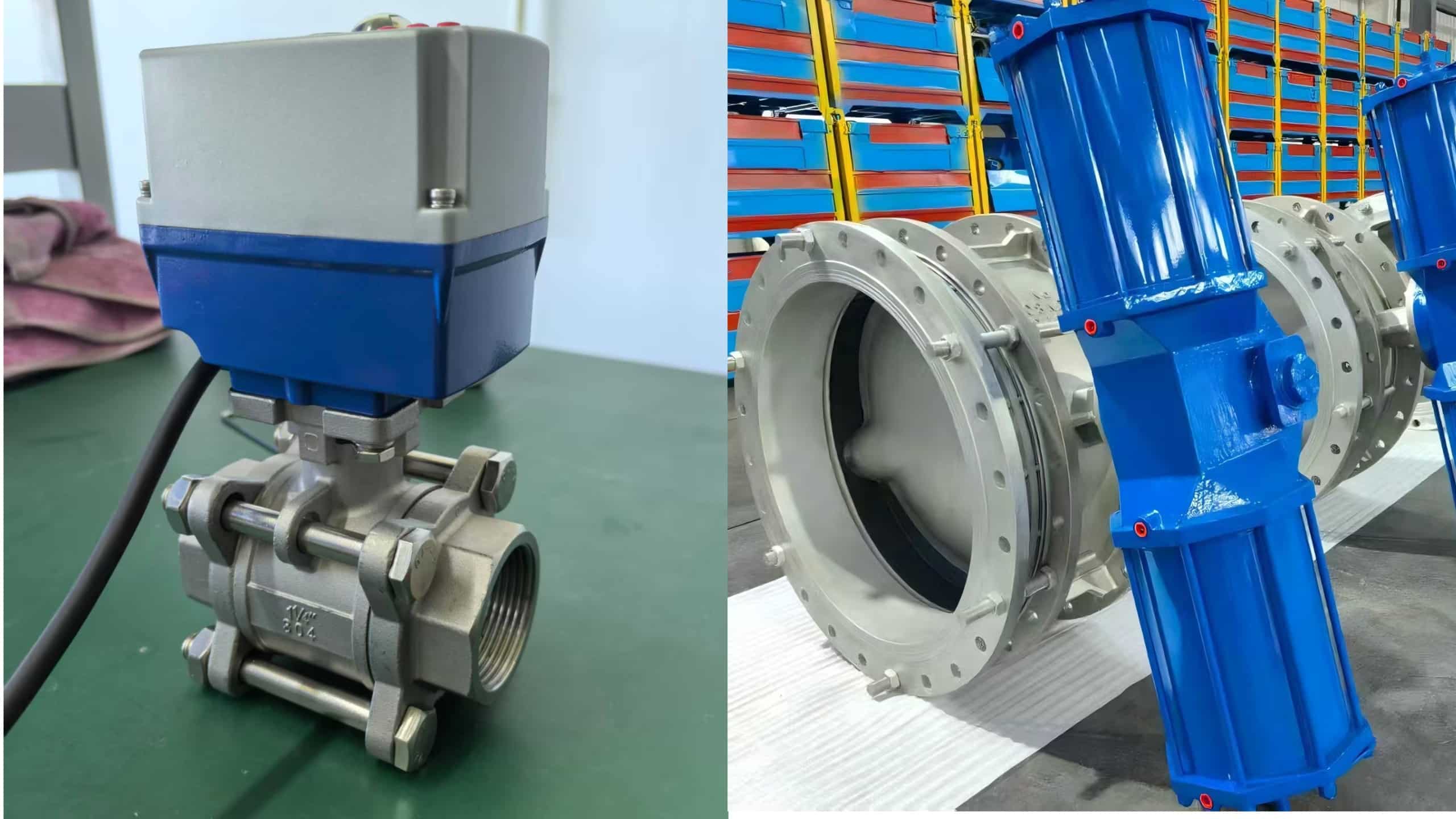
Pneumatic actuators are devices that rely on compressed air to generate rotary or linear movement for valve actuation. They are generally found in heavy, duty industrial settings where high torque output, rapid response, and operational safety are a must. Because of their straightforward mechanical design and non electrical energy source, pneumatic actuators are inherently safe for explosive, hazardous, high, cycled areas that are typical in the oil & gas, refinery, petrochemical, and offshore industry sectors.
The ability of pneumatic actuators to deliver the same torque even if the process parameters fluctuate, is the reason why these devices are chosen as the most feasible ones for critical isolation and emergency shutdowns, where dependable performance is a must for plant safety and uptime.
Key technical characteristics
- High torque to size ratio
- Rapid actuation speed
- Simple mechanical construction
- Safe in explosive atmospheres
Typical industrial applications:
- Oil&Gas: Pipeline isolation, emergency shutdown systems
- Refineries: High-cycle on/off valve operation in process units
- Petrochemical plants: Reliable actuation in corrosive systems
- Marine&Offshore: Safe operation in hazardous offshore zones
Pneumatic actuators are combined with valves made of F51 Duplex, F53/F55 Super Duplex, C276 Hastelloy, or Inconel 625, the final choice depending on the service environment.
Electrical Actuators: Technical Overview
Electric actuators employ an electric motor along with a gear mechanism to operate industrial valves. Their use is very extensive in systems where exact positioning, controlled actuation, and the connection with centralized automation platforms are demanded. Besides that, electric actuators are most suitable for installations which put accurate modulation, remote monitoring, and the minimum use of the auxiliary utilities such as the compressed air systems in the first place.
Being equipped with enhanced control features and compatible with the current plant automation architectures, electric actuators are chosen for driven and the utility focused industrial applications.
Key Technical Characteristics
- Precise position control for modulating operation
- No reliance on compressed air systems
- Great for remote and unmanned locations
- Less actuator noise
Typical Industrial Applications
- Power Generation: Cooling water and auxiliary systems
- Water & Wastewater: Automatized treatment and distribution networks
- Desalination Plants: Intake, discharge, and chemical dosing systems
- Mining: Utility and process water services
In most cases, electric actuators are combined with Titanium Grade 2, Aluminium Bronze C95800, and Incoloy 825 valves that are resistant to corrosion.
Electric and Pneumatic Actuators- Technical Comparison
| Parameter | Pneumatic Actuator | Electric Actuator |
| Power Source | Compressed air | Electrical supply |
| Torque Capability | Very high | Moderate to high |
| Actuation Speed | Fast | Slower |
| Hazardous Area Suitability | Excellent | Requires explosion-proof design |
| Positioning Accuracy | Limited | High |
| Maintenance | Low | Moderate |
| Fail-Safe Capability | Easy (spring return) | Complex / battery-based |
Industry specific Actuator preferences
| Oil & Gas | Pneumatic Actuators | Fast response time and reliable fail safe operation make pneumatic actuators preferable for emergency shutdown and pipeline isolation systems. |
| Refineries | Pneumatic Actuators | Pneumatic actuators, as a result of being designed for high- cycle operation, are able to enhance the reliability and lower the downtime in continuous process units. |
| Power Generation | Electric Actuators | Electric actuators are used for automated control and precise positioning in auxiliary and balance- of-plant systems. |
| Water & Wastewater | Electric Actuators | Centralized control capability is allowing efficient flow regulation all through treatment and distribution networks. |
| Desalination | Electric Actuators | Accurate control as well as compatibility with valve materials resistant to corrosion support long, term operation in saline environments. |
| Marine & Offshore | Pneumatic Actuators | Intrinsic safety and designed for hazardous atmospheres make pneumatic actuators a safer choice for offshore installations. |
| Pulp & Paper | Electric Actuators | Precise modulation and integration with plant automation systems support efficient control of utility and process flows. |
| Mining & Minerals | Pneumatic Actuators | Sturdy construction and high torque capability, pneumatic actuators are the most viable option for abrasive media and harsh environments of operation. |
Key Selection Criteria for Industrial Valve Actuators
- Safety and Hazard Classification
In scenarios where the risk of explosion or fire is present, pneumatics are the safest and are thus preferred. However, if electrically driven actuators are to be used, they should be enclosed in certified flameproof or explosion proof enclosures.
- Torque Requirements
The operating torque of the valve may be increased due to its size, the pressure of the medium, or the required tightness of the shutoff. Pneumatic actuators are usually the ones that can handle such situations.
- Control Philosophy
Electric actuators can be used for modulating control and precise positioning, where pneumatic actuators cannot. Pneumatic actuators are generally used for On/Off and ESD functions.
- Infrastructure Availability
Where no compressed air system is installed, the facility is more likely to use electric actuators. On the other hand, refineries and offshore platforms are usually equipped with pneumatic actuation as a standard practice.
- Environmental Exposure
Actuators for marine and offshore installation should be made of materials that are resistant to the corrosive nature of the atmosphere. The selection should be consistent with the valve material grades, for instance, Super Duplex F55 or Aluminium Bronze C95800.
Choosing either pneumatic or electric actuators is an essential engineering decision that impacts the safety, production time, and risk level of an industrial plant. A pneumatic actuator can actively shut down the system in emergencies, operate in hazardous environments, and handle high-torque applications in oil & gas, refinery, and offshore systems. In contrast, an electric actuator, commonly used in automation, enables remote operation and precise control in power generation, water & wastewater, and desalination plants.
As a trusted Supplier in USA, Valves Only provides engineered actuator solutions tailored to these demanding industrial applications.