
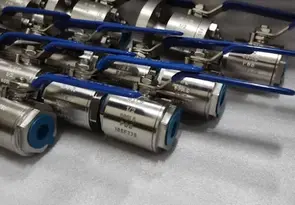
In the oil and gas sector, valves are very important because they control flow, separate systems, and make sure that things are safe in upstream, midstream, and downstream operations. Reliable, strong oil and gas valves let LNG terminals, oil refineries, offshore platforms, and high-pressure pipelines control hydrocarbons under high pressure, heat, and corrosive conditions. Choosing the ideal valve for each application depends on knowledge of design principles, operational requirements, and material compatibility.Often judged on its capacity to supply valves satisfying these demanding performance and legal criteria is a Valve Manufacturer in USA.
Valves Only delivers engineered valve solutions to meet the operational, safety, and regulatory requirements of industrial projects.
Types of Valves Used in Oil and Gas
Different valve types are employed in oil and gas activities according to flow control, pressure rating, and operational needs, each fit for certain uses. Among the most often found are:
- Gate Valves: There are pipeline full-bore isolation valves with hardly any pressure loss.
- Ball Valves: Quarter-turn valves with low torque and tight shutoff are employed in pipelines, wellheads, and underwater systems.
- Globe Valves: Linear-motion valves provide perfect flow control as well as throttling.
- Check Valves: Stop backflow to protect vital pumps and equipment.
- Butterfly Valves: Quarter-turn valves that are lightweight for big diameters and moderate-pressure service.
- Plug Valves: Off/on valves erode and corrosive fluid resistant.
- Needle Valves: Usually in instrumentation or sampling, let outstanding flow control be in place.
- Diaphragm Valves: Provide excellent sealing in systems with corrosive or abrasive liquids.
- Cryogenic Valves:Usually at LNG terminals, work in quite cold environments.
The sort of valve chosen relies on factors including line pressure, fluid qualities, flow rate, and degree of accuracy needed in controlling it. Sophisticated oil and gas systems may combine several valve kinds to ensure safe and efficient running.
Operational Requirements
For oil and gas uses, valves have to satisfy very stringent operational requirements:
- Pressure Ratings:Depending on how they are utilized, valves need to tolerate ANSI Class 150 to Class 2500 pressure.
- Temperature Ranges: From -50°C for polar applications to +450°C for refining needs.
- Flow Control Precision: Among the activities needing perfect throttling include chemical injection, refining or metering.
- Corrosion Resistance: Valves have to be able to handle H₂S, CO₂, and other powerful hydrocarbons.
- Erosion Resistance: For items like sand, abrasive fluids, or hydrocarbons having particles in them, you want erosion-resistant materials.
Working with a licensed Valve Manufacturer in USA ensures design compliance and material quality to satisfy these high expectations.
Actuation Methods for Oil & Gas Valves
Oil and gas system valves sometimes need actuation for accurate flow control, remote operation and emergency shutdown. Common actuation methods include:
- Manual Actuators: Suitable for low-frequency applications or small valves.
- Pneumatic Actuators: Offer fast and reliable motion for large or high-pressure valves.
- Hydraulic Actuators: Handle tasks with large torque and heavy duty.
- Electric Actuators: Permit exact modulating control as well as interaction with SCADA or DCS systems.
Key considerations when selecting actuators:
- Required torque based on valve size and pressure
- Operating pressure and temperature
- Safety margins during emergency situations
- Among environmental elements, being offshore or under the surface of the water
Choosing the appropriate actuator ensures reliable performance, safe operation in pipelines, processing plants and offshore platforms as well as durability.
Materials and Corrosion Management
Material selection is critical for operational safety and durability:
| Valve Component | Typical Materials |
| Body | ASTM A216 WCB, A352 LCC, CF8, CF8M |
| Trim | Stainless steel, Duplex, Inconel, Monel |
| Ball/Plug | Forged stainless steel, hard-coated alloys |
| Seats | PTFE, RPTFE, PEEK, Metal |
| Seals | Graphite, PTFE |
Resistant to corrosion metals, coatings and hardening methods guarantee valves live through saltwater, sour gas, and high-temperature settings sometimes seen in the offshore and refining industries.
Automation and Control
Modern oil and gas operations frequently call on automated valves for remote control and exact flow control. Automation lets interface with SCADA or DCS systems, raises safety and minimizes exposure to dangerous surroundings. Key features include:
- Actuator Compatibility: Pneumatic, hydraulic, or electrical actuator valve torque and functional needs help to characterize them.
- Torque Stability: Under difficult situations, ball valves and trunnion-mounted valves offer trustworthy torque.
- Cycle Reliability: Automatic valves can open and close several times without wear.
- Remote Monitoring: Integration with control systems provides flow changes, emergency shutdowns and predictive maintenance data.
Automation guarantees operational efficiency by keeping pipelines, processing units and undersea installations under difficult circumstances in flow control.
Pressure and Temperature Capabilities
Oil and gas valves must accommodate extreme conditions:
| Parameter | Typical Range |
| Pressure | ANSI Class 150–2500 |
| Temperature | -50°C to +450°C |
| End Connections | Flanged, Butt Weld, RTJ |
| Operation | Manual, Electric, Pneumatic |
| Design Standards | API 6D, ASME B16.34 |
| Fire Safe Compliance | API 607 / API 6FA |
Designed within these ranges, valves offer dependable isolation and flow control in downstream, midstream, and upstream applications.
Pressure Management and Safety Features
Reliability in operations and safety are absolutely vital. Oil and gas valves commonly have:
- Blowout-proof stems to prevent ejection under pressure
- Fire-safe sealing to maintain isolation during fire events
- Cavity pressure relief to safely release trapped fluid
- Anti-static devices to prevent ignition in volatile environments
These design features help high-pressure pipelines and processing systems reduce risk, ensure compliance with rules, and raise operational safety.
Flow Characteristics and Pressure Drop in Oil & Gas Valves
Effective valve and pipeline operation depends on an awareness of flow behavior.
- Complete-bore valves (such as gate and ball) have a low pressure drop and a high flow capacity.
- Throttling valves, such as globe and needle valves, can precisely control flow but add more resistance. They are known as reduced-bore valves.
- Flow coefficient (Cv) directs sizing to guarantee adequate efficiency and capacity.
- Pressure drop affects system stability, pump size, and energy use.
Choosing valves according to their flow features guarantees:
- Reliable process performance
- Less energy loss
- Under long-distance pipeline conditions and high-pressure, safe and dependable functioning is possible.
Valve Selection Criteria for Oil and Gas Applications
Choosing the best valve depends on operating circumstances, service kind, and desired functionality as well as other factors.
| Application Segment | Valve Types Commonly Used | Key Selection Considerations |
| Upstream (Exploration & Production) | Ball, Gate, Check, Subsea Valves | High pressure, multiphase fluids, remote operation |
| Midstream (Transmission Pipelines) | Ball, Gate, Check, Butterfly | Flow isolation, emergency shutdown, pressure rating |
| Downstream (Refining & LNG) | Globe, Control, Ball, Cryogenic | Precise flow control, high-temperature resistance, corrosion management |
Engineers and project teams use this table to select valves meeting both environmental and functional criteria.
Conclusion
Oil and gas firms depend on valves since they regulate flow, offer isolation, and guarantee safety across upstream, middle stream, and downstream activities. Their dependability, efficiency, and compliance all depend directly on their design, materials, and pressure resistance ability. Engineers can choose solutions fit for certain process requirements once they understand the mechanical principles behind each valve type ball, gate, globe, butterfly, and submersible or cryogenic valve. Reliable performance gets better. Performance in demanding, high-pressure or high-temperature conditions is guaranteed by automation, torque control, and pressure-assisted sealing.
Valves Only is a technical resource for matching strong valve design with safe and effective operations, hence offering useful insights into valve applications and design factors.
Recent Posts
- Valves Used in Steel and Metal Processing Plants: Types, Functions, and Applications
- Pressure Seal Gate Valves: Design Principle and High-Pressure Service
- Understanding the Role of Valves Used in Wastewater Treatment Plants
- High-Performance Butterfly Valves: Design Features and Operating Range
- Valves Used in Downstream Refining Operations